The Syce
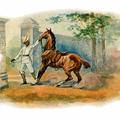
A drawing by the painter M.V. Dhurandhar that animates the meaning of "syce" as having to do with "coaxing." It was defined by Hobson-Jobson (1906): "SYCE (p. 885) SYCE , s. Hind. from Ar. sāïs. A groom.

A drawing by the painter M.V. Dhurandhar that animates the meaning of "syce" as having to do with "coaxing." It was defined by Hobson-Jobson (1906): "SYCE (p. 885) SYCE , s. Hind. from Ar. sāïs. A groom.
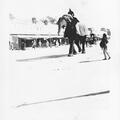
A real photo postcard likely made and sold by a photographer or vendor to tourists visiting Jaipur.
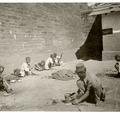
A rare real-photo court-sized postcard taken inside Almora Jail. Sent to Miss Nancy Iverson in Ealing London and postmarked Almora, Nov. 2, 1904: "Prisoners at work Almora Jail Love Daddy."
![The Post Office in British India [La Poste Aux Indes Anglaises]](https://www.paperjewels.org/sites/default/files/styles/square_thumbnail/public/slides/post-of-india_0.jpg?itok=OSUkuckm "The Post Office in British India [La Poste Aux Indes Anglaises]")
An early postcard by the French branch of the premiere Zurich, Switzerland-based publisher Kunzli Freres. The firm's postcard series celebrating mail delivery around the world (see the Kashmir post) are among the most beautiful lithographic
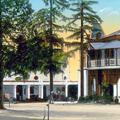
When Rudyard Kipling visited Mussoorie in the summer 1888, he wrote two verses by hand in a book of photographs in an album of photographs by Alex Hill (now in the Library of Congress in Washington D.C.), which can be found on the website of The
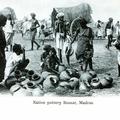
A rich scene and well-preserved collotype to match, photographic in spontaneity and effect. One woman is glancing up from the pots, oblivious to another handing her one. Some men look at the camera, others walk by indifferent.
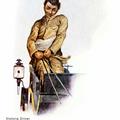
A lovely character sketch by the artist M.V. Dhurandhar of a carriage driver in turn of the century Bombay.
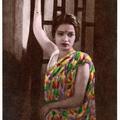
A rare early Bollywood star postcard, though the movie the still is likely taken from, and the sad-looking star are unknown.
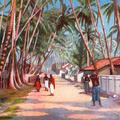
[Original caption] Road near Colombo. This is the very fringe of Pettah or native quarter of Colombo. Coconut palms shade it from the hard blue sky and "the state o the sun"; the noise of brass-workers goes on incessantly under the bright red roofs.
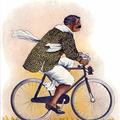
A satirical postcard showing a "Baboo," which Hobson-Jobson defined as used in Kolkata "with a slight savour of disparagement, as characterizing a superficially cultivated, but too often effeminate, Bengali," pulling ahead on the most modern of
