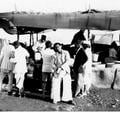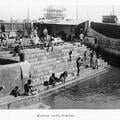
Natives Jetty, Karachi
By the 1920s, Karachi's port had become one of the most commercially significant in the British Empire — by 1910, it was said to already be handling more wheat than any other port in the British Empire.
The Madras Club is a colonial-era gentlemen’s club in Chennai, founded in 1832 as an exclusive European male preserve and now one of India’s oldest surviving social clubs.
[Original] This city built by the Emperor Shahjahan in 1627 A.D. [end]
Cherat hill’s position gave commanding views over the Peshawar valley and toward Kohat/Indus, which made it strategically useful as well as climatically attractive to colonists.
John & Co., Ceylon was an early 20th‑century commercial postcard and view‑card publisher based in Colombo (and very likely also Kandy), part of the broader trade in photographic and printed views of colonial Ceylon.
Numerous conqueror's came into the subcontinent through the Khyber Pass, including Darius I of Persia, Alexander the Great, Mahmud of Ghazni, Muhammad of Ghor, Timur (known as Tamerlane in the west), Babur, Nader Shah and Ahmad Shah Durrani.
Maharaja’s College, Mysore is one of the oldest and most influential centres of higher education in southern India, closely tied to the making of the University of Mysore and to the Wadiyar dynasty’s education policy.
Indian workers were brought over by the British to the West Indian island of Jamaica between 1845 and 1917. Roughly 37,000 people were brought over under an indentured labor system, where they had to work on mostly sugar estates, where strict
Upper Topa in the Murree Hills was established by the British during colonial rule as a military base, and today hosts the Military College Murree at an altitude of over 2,000 metres.
The Black Hole of Calcutta was made famous by an account written by John Hollwell, now disputed.
In 1756, the Nawab of Bengal, Siraj-ud-daulah captured Fort William and took a number of European prisoners who were unable to escape.