Courtyard India Pavilion
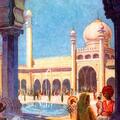
The British Empire Exhibition in 1924 was promoted with many a series of postcards by British publishers, including a series by the artist Ernest Coffin, of which this though unsigned seems to be an example.
The British Empire Exhibition in 1924 was promoted with many a series of postcards by British publishers, including a series by the artist Ernest Coffin, of which this though unsigned seems to be an example.
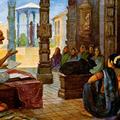
This image by the Indian painter M.V. Dhurandhar manages to convey a real sense of personality and drama to the situation through the face and gesture of the priest.
Sent to Miss C. Blackwood, R.D. Route No.
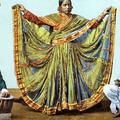
A finely hand-tinted postcard and gorgeous display of color.
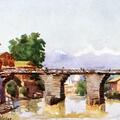
[Verso, handwritten] "C.S.MS Missionary, now retired. So sorry, I forgot to provide stamps on the envelope I posted yesterday. I enclose 2 to make amends. With love A."
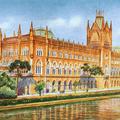
[Original caption] High Court. West of Government House, Calcutta, and nearer the river, stand the Law Courts, built in 1872, and said to be modelled on the beautiful Town Hall of Ypres in Belgium. [end]
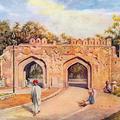
[Original caption] Kashmere gate. Looking from the ridge whence the columns marched in 1857, when Nicholson stormed the breach in the Kashmir bastion and bought Delhi for ever with British blood.
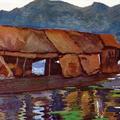
A self-published postcard by Miss Barne of St. Ebbas, Madras [Chennai], apparently an amateur painter.
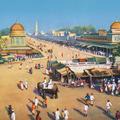
[Original caption] Street Scene. The city of Jeypore, situated 850 miles north-west of Calcutta, is handsomely and regularly built, and is the most important centre of Rajputana.
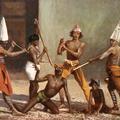
[Original caption] Devil Dancers, Calcutta. The Devil Dancer with his painted body, hideous mask, and fantastic head-dress is supposed to strike terror unto the beholder; as a rule he but succeeds in amusing him.
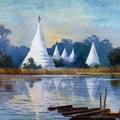
[Original caption] Pagodas by Moonlight. A group of pagodas in Mandalay by the brilliant light of a tropical moon. [end]
Edith Pinhey, married to a judge in Bombay, was an artist and one of the few women to have signed Tucks postcards of the
