
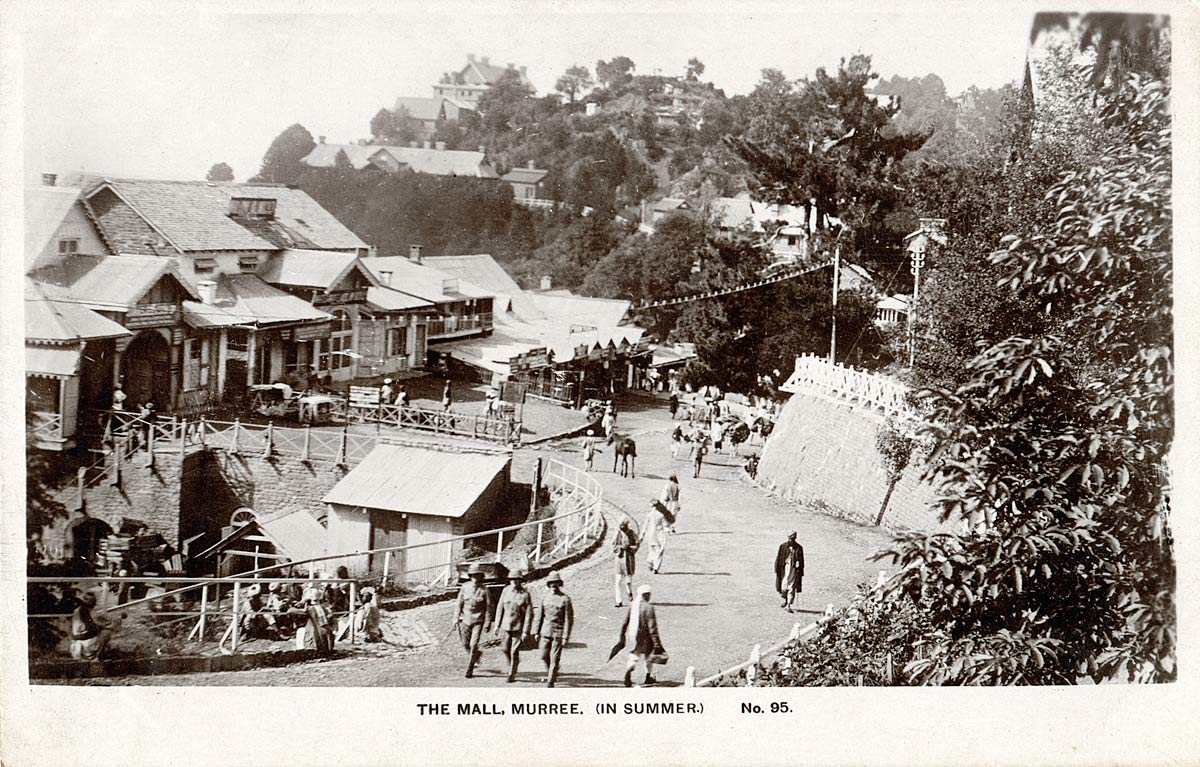
"The Mall, far from serving merely as a site for commerce or recreation, functioned as a symbolic and material articulation of imperial hierarchy, controlling access to commodities and visibility, and reinforcing notions of prestige, superiority, and separation from the local population (Legg 2007, 46). Despite its centrality to colonial urban life, the strategic role of the Mall as a deliberately produced space of consumption remains under-researched. Examining the Mall Road through this lens opens up critical questions about how imperial power was sustained through everyday practices of leisure, consumption, and spatial control, warranting closer scholarly attention," write Rohan Kumar Narwan and N. Christhu Doss in their excellent article (free) Mall Roads and the Spatial Embodiment of Colonial Exclusivity (p. 2).
They show how important these Mall Roads (the word comes from the original "Pall Mall" in London) were in nearly every city and cantonment of British India. They reflected, literally on the ground, imposition of Raj hierarchies and racism and ideas about sanitation, commerce and order. "Within this framework," continue the authors, "the Mall Road emerged as a paradigmatic colonial space in which leisure, visibility, mobility, and consumption were meticulously orchestrated to privilege European elites while simultaneously marginalising, disciplining, and controlling the native population," (p. 6). This postcard, with the British army officers in the foreground, shops catering largely to Europeans in the background, a church hidden from view on the right, and the broad avenue running through the top of the hillstation encapsulates many of the points in their fascinating paper.