
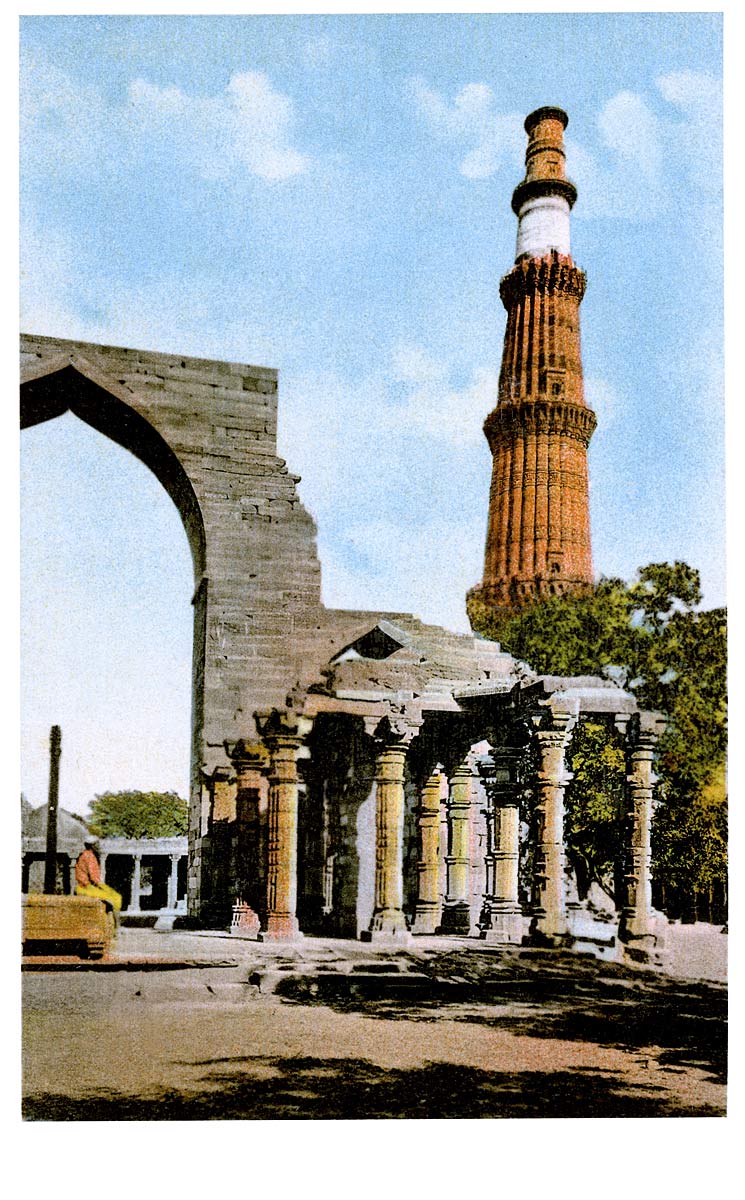
The Quwwat ul Islam Mosque located in the Kutab complex is a magnificent ruin, and a very popular tourist location today. This transformation began much earlier. As Aditi Chandra recounts in her book Unruly Monuments Disrupting the State at Delhi's Islamic Architecture (2025), "by July 1922, the villagers had lost their lands and were evicted to make way for the increasing number of carriages and motorways going to the Qutb," (p. 93). Some of this growth was propagated by the postcard; around the time villagers were evicted, a new publisher, H.A. Mirza and Sons managed to acquire permission from the Archaeological Survey of India to operate a postcard stall on the premises. From 1892-1911 however, it was the publisher of this postcard, the Archaeological Photo-work, that did business at the site (Chandra, p. 109).
Note how nicely the photographer has framed this image: Chandragupta II's (reigned 375–415 CE) 7 meter iron pillar is tucked beneath the arch on the left, dwarfed by the 13th century Qutb tower almost 30 meters high.