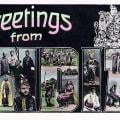
A "Greetings from India" postcard composed of many images, each of which were also separate postcards, within stenciled letters. On the back the owner wrote "What do you think of the square tacks?"
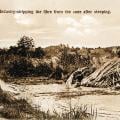
"Another sign of the transition from the wet to the dry season was to be seen in the immense number of jute-stem stacks standing on every field and lawn," wrote Nirad Chaudhry in his Autobiography of an Unknown Indian.
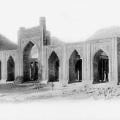
A striking collotype published in many versions by Clifton & Co. The Arhai-Din-Ka-Jhopra was built in the 13th century by the first Muslim Sultan in India, Qutb-ud-Din Aibak, and before him by Abu Bar of Herat, Afghanistan.
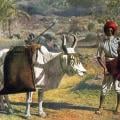
Bullocks that ferried water were called "water bullocks." This colored image by Clifton & Company, one of the earliest mass publishers of postcards in Mumbai (Bombay) was fairly popular, perhaps because of its rich colors.
In Ali Raza's excellent book Revolutionary Pasts Communist Internationalism in Colonial India (Tulika Books, 2022) there is this note from a police report in 1926: "A public meeting was held . . .
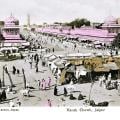
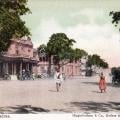
Gobindram Oodepyram produced a number of hand-tinted, two colour, postcards like this one where the pink, for example, is strategically deployed to lead the eye down the broad avenue.
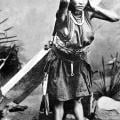
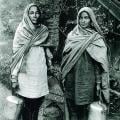
Although taken in the firm's studio, with the woman posing upright, one can from this portrait and the wooden beam infer the literally backbreaking work hillstation workers endured.
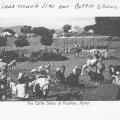
An embossed frame sets off a rare early postcard of what is presumably the famous Pushkar fair, with the colonial perspective of a onetime owner scrawled across the top: "Does not look much like our Cattle Shows."
The most important road in Chennai, now known as Anna Salai, and originally known St. Thomas Mount Road. It ran from the European settlement at Fort St. George to St. Thomas Mount where the Apostle St. Thomas ("Doubting Thomas") was killed in 72 CE.
This postcard is likely based on a portrait by Johnston & Hoffmann of 22 Chowringhee [also Chourangi] Road, Kolkata, one of the most storied photographic firms in British India.