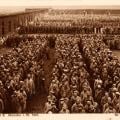
Prisoners, many of whom would have been from India, lining up at the German prisoner of war camp in Munster. Note that the postcard title is actually in French (L'Appel or Roll Call).
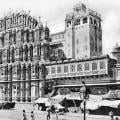
Built in 1799 with nearly a thousand tiny lattice-screened windows from which ladies of the court could observe street scenes, it is one of the city's top destinations for visitors today who can momentarily partake of what must have been exquisite…
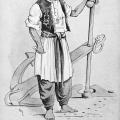
Bengal's rivers were traversed by boats and steamers, on which this man served a captain. The firm he worked for, "I.G.S.N." is likely emblazoned on his shirt.
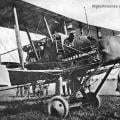
A British fighter plane, called "Rawalpindi" and named after the 29th Punjab regiment, brought down in apparently excellent condition by German forces during World War I. Note that the regiment, composed of Sikhs and Punjabi Muslims actually served…
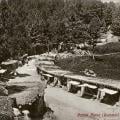
A quintessential bazaar near an army base next to the hill station of Murree. From an albumen photograph as the inscribed title and photographer's name on the glass plate show.
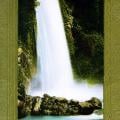
As the postcard business became increasingly competitive, especially after about 1905, printers and publishers went to great lengths with frames and colours to distinguish their products.
Much of the early postcard market was driven by collectors who exchanged cards with each other around the world, as this text on this card illustrates. Addressed to Frau Emma Valenti in Trieste, Austria:
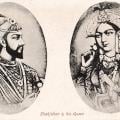
Mughal Emperors continued to live centuries after their death on postcards, most likely based on oval ivory portraits sold to tourists. The Queen here would have been Mumtaz Mahal, for whom Shah Jahan built the Taj Mahal.
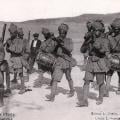
Indian troops in France brought their own music bands which created great interest among the French, who attended concerts in towns where these men performed. Note the dhols and flutes shown here.
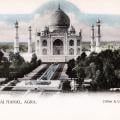
One version of this card, addressed to Miss J. Flint, 124 Belmont Road, Ansfield, Liverpool, has this written on the front: "I wonder whether they will build anything like this over us when we are gone. W.J.O."