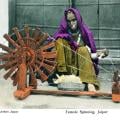
A popular Jaipur postcard shows a woman spinning cotton in front of a traditional door. The colors were applied by hand and with a stencil to a black and white printed postcard, fairly accurately, although drops coming off the wheel on left are…
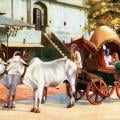
[Original caption] Zenana Carriage, Jeypore. This picture of the quaint and thoroughly Oriental-looking vehicle was taken in a street of Jeypore, the capital of the state of that name in Rajputana.
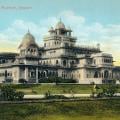
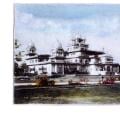
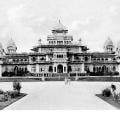
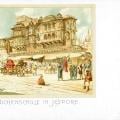
Compare this to an earlier color postcard of the Albert Museum by the same firm from the same image, made when color printing of postcards from photographs was much less sophisticated, at least on a level where costs were low enough for mass…
A very early postcard of Jaipur, made from an albumen print, title and photographer visible in white where it was inscribed onto the albumen negative. The color was applied through hand-tinting.
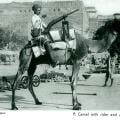
One of the more unusual forces in Rajputana during the Raj was the Bikaner Camel Corps which "had such camels also on which 'jujarbas' or small cannon were mounted" (Nandakiśora Pārīka, Jaipur that was: royal court and the seraglio, p. 130).
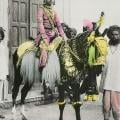
Seated on a horse, this Jaipur Sardar wears a traditional dress and looks very bored indeed. The descendants of the earlier princely states of Jaipur were often called "sardars".
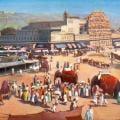
[Original caption] The Chowk and Howa Mahal. This is a picturesque and animated scene. The inhabitants of Jeypore are a busy people, and their bazaars are generally crowded.
Albert Hall was opened in 1887 and designed by the British architect Sir Swinton Jacob. Now a museum, famous for its magnificent collection of paintings, crystal works, statues of stone, metal and ivory and carpets, it also houses a modern art…
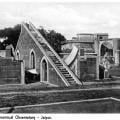
Jaipur’s relationship to the heavens had many facets, from the laying of the main avenue on an East–West axis between “the gates of the sun and moon,” to Maharajah Sawai Ram Singh’s personal fascination with astronomy.