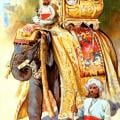
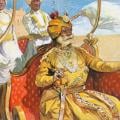
An early Tuck's painted postcard made to celebrate the 1903 Delhi Darbar. Viceroy Lord Curzon and his wife Mary are atop the elephant, their arrival opened the Darbar.
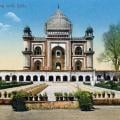
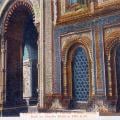
The low angle of this splendid postcard of the mid-18th century tomb of Nawab Safderjung seems to widen at the bottom and reach towards the viewer. Note the two figures in white, almost invisible against the whitewash of the pedestal.
The final of the great three Darbars in Delhi - 1897, 1903 and 1911 - was also the most "postcarded" of Darbars, with numerous publishers seeking to out do each other with series illustrating the spectacle.
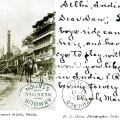
One of the earlier firmly dateable postcards by H.A. Mirza & Sons, the Chandni Chowk photography firm which was to become the dominant Delhi and northern Indian postcard publisher by 1905.
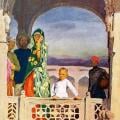
An early Tuck's painted postcard, and one of the earliest numbered series (2623) with an Indian theme. The theme suggests that the cards represents the Delhi Darbar of 1903 as other cards include the Viceregal Party.
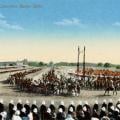
[Original caption, Verso] “Watching the Pageant, Delhi. The great Delhi Durbar is known by means of the vernacular press to the inhabitants of the remotest parts of India.
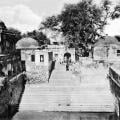
The Well at Sultan Nizamuddin in Delhi was constructed in 1321 in honor of Shaikh Nizamuddin Auliya (1236-1325) a SUfi saint who arrived in India long before the Mughals and preached a religion of love and mysticism.
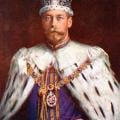
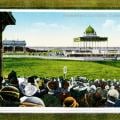
A nicely framed view of the 1911 Durbar, with an Impressionist's blend of hats and heads, the first and only which a British monarch George V attended and was honored under an Oriental pavilion. It was the high noon of postcards too.