A Boothea Milkman
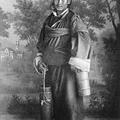
A studio portrait full of contradictions. The milkman from Darjeeling of Tibetan ancestry is shown with an English church in the deep background.
A studio portrait full of contradictions. The milkman from Darjeeling of Tibetan ancestry is shown with an English church in the deep background.
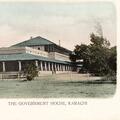
A very early coloured postcard of what is now the official residence of the Governor of Sindh, across of Frere Hall in the center of the city. Nusserwanjee & Co.
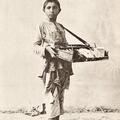
A rather impressive portrait, from a slightly low angle, giving the boy a certain grandeur. Unfortunately, a most rarely postcarded occupation.
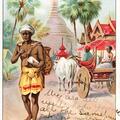
Part of a series showing postmen around the world. This was postmarked in Spalding, Britain,May 6, 1905 and addressed to Mr. G. Riseley, 41 Norfolk Street, King,s Lynn: "Parcel arrived safely. Vest too large, others a fit. Jack."
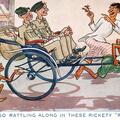
Part of a series of calendar and regular postcards by the Kolkata artist Merton Lacey made for US troops in the city supporting the Allied front against Japan and supporting China during World War II.
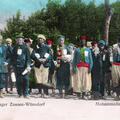
During the first World War, the Germans held their captives at a number of camps, and Muslims in particular would find themselves at Zossen-Wunsdorf not far from Berlin.
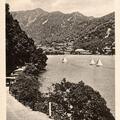
Gangi Sah was one of the first postcard publishers from Nainital, if not the earliest.
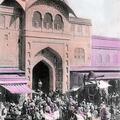
A very rectangular two-colour stencil proves very effective in bringing this postcard to life.
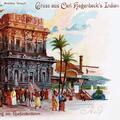
An early Exposition postcard by a German exotic people's promoter and founder of the modern zoo. In this early postcard, the name of the printer is given towards the top left corner (Th. Wendisch, Berlin S.W.
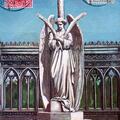
[Original caption] The Statue, Memorial well.
