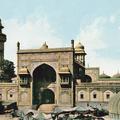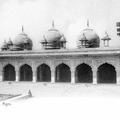
Pearl Mosque, Agra
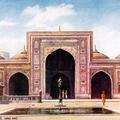
The Moti Masjid inside Agra Fort was a private royal mosque commissioned by the Mughal emperor Shah Jahan and built in the mid-17th century, using white marble that gave it the “pearl” name.
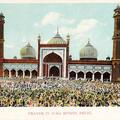
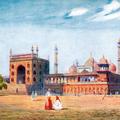
This is a superbly hand-tinted postcard, with both swathes of color (pink and blue) and individual color specs in the crowd mixed with the black ink of the collotype enhancing the effect of a real crowd praying.
Shaikh Ilm-ud-din Ansari, known as Wazir Khan, built this mosque in the 17th century. Wazir Khan's mosque is in the heart of Lahore's walled inner city, surrounded by narrow lanes and crowded bazaars.
The view of Lahore from the minarets is fabulous
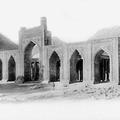
A striking collotype published in many versions by Clifton & Co. The Arhai-Din-Ka-Jhopra was built in the 13th century by the first Muslim Sultan in India, Qutb-ud-Din Aibak, and before him by Abu Bar of Herat, Afghanistan.
[Original caption] Dhurmtollah Musjid. One of the busiest localities of Calcutta. It is noticeable that in Dhurmtollah Lane, the names on the shops and offices are all native names while close by in Dhurmtollah Street they are chiefly European.
[Original caption] Wazir Khan's Mosque (Inner Part) Lahore. The mosque was designed in Hidayat-ul-lah, faithful servant of Wazir Khan and was built in 1634. The brick walls are covered with beautiful inlaid work, a kind of mosaic of glazed pottery
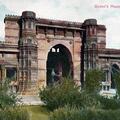
Among the earliest postcards – and certainly early color postcards – of Ahmedabad is this view of Rani Rupamati's Mosque, built in the early 15th century and still standing.
[Original caption] The great mosque, 200 years old, is a marvel of Indian architecture.
A postcard sent from Bareilly in UP to a woman in France in 1905 shows how the placement of stamps was on the front of a postcard was once itself a performative art.
[Original caption] A Street Scene, Pydowni Junction. A typical street scene in Bombay. [end]