Prayer in Juma Masjid, Delhi
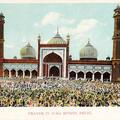
This is a superbly hand-tinted postcard, with both swathes of color (pink and blue) and individual color specs in the crowd mixed with the black ink of the collotype enhancing the effect of a real crowd praying.
This is a superbly hand-tinted postcard, with both swathes of color (pink and blue) and individual color specs in the crowd mixed with the black ink of the collotype enhancing the effect of a real crowd praying.
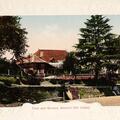
A thickly embossed and framed postcard, a treatment that seems to be more prevalent among hillstation postcards.
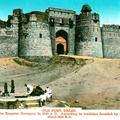
[Original caption] Repaired by the Emperor Humayun in 1540 A.D. According to tradition founded by Pandav King, about 1400 B.C. [end]
A postcard which illustrates how intertwined the printing and publishing of postcards could be among firms.
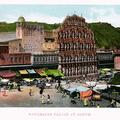
One of the more richly coloured postcards of the Hawa Mahal, built in 1799. Note the care with which individual blankets have been tinted in the foreground.
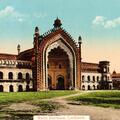
Rumi Darwaza is an iconic gateway located in the heart of Lucknow, India.
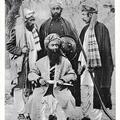
Postcards of Pathans who inhabited the North West Frontier Province (NWFP, now Khyber Pakhtunkhwa) bordering Afghanistan were often shown with their weapons, in poses that made them see dangerous.
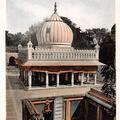
Princess Jahanara's Tomb was built during her lifetime and completed in 1681, the year of her death.
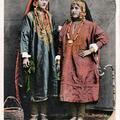
Much of the early postcard market was driven by collectors who exchanged cards with each other around the world, as this text on this card illustrates. Addressed to Frau Emma Valenti in Trieste, Austria:
"Madame,
Your cards to hand.
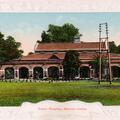
Hospitals found there way on to many postcards, symbols of progress that probably reflected colonial health concerns.
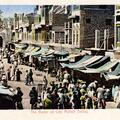
A rare postcard of one of the oldest and largest cities in southern Punjab. Note the telephone wires floating just above the stalls.
