Zenana in the Fort, Agra
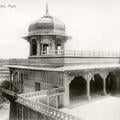
A sharp diagonal composition; in the distance is the Taj Mahal. The zenana refers to the women's quarters in this 16th century fort, largely completed under the Mughal Emperor Akbar.
A sharp diagonal composition; in the distance is the Taj Mahal. The zenana refers to the women's quarters in this 16th century fort, largely completed under the Mughal Emperor Akbar.
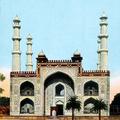
Akbar started building his own tomb at Sikandra, but it was completed by his son Jehanghir in 1605. Although it said that a central dome is missing on this edifice, it remains one of the most exquisite of Mughal gates.
[Verso] "23.8.11 Dear Molly,
![[Woman at loom]](https://www.paperjewels.org/sites/default/files/styles/square_thumbnail/public/slides/woman-at-loom_0.jpg?itok=KOmoyvGo "[Woman at loom]")
K. Lall & Co. were a publisher of interesting real photo postcards, like this one of a cotton spinner, whose flat composition speaks to a style of portrait photography not common among photographers.
![India Tea Growers Post Card [back]](https://www.paperjewels.org/sites/default/files/styles/square_thumbnail/public/slides/tea-card-back_0.jpg?itok=zMlAOWq1 "India Tea Growers Post Card [back]")
The back of the Mumtaz-i-Mahal postcard, with an advertising message for tea and the ink stamp of the sales agent.
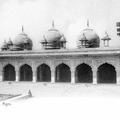
The Moti Masjid inside Agra Fort was a private royal mosque commissioned by the Mughal emperor Shah Jahan and built in the mid-17th century, using white marble that gave it the “pearl” name.
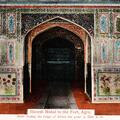
[Original caption] Built during the reign of Akbar the great in 1599 A.D. [end]
An apparently delicately stenciled postcard where the dense but eroded condition of the original panels are veiled by loosely applied tints.
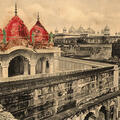
An extremely rare postcard from India where stamps have been cut and pasted on the domes of the mosque.

One version of this card, addressed to Miss J. Flint, 124 Belmont Road, Ansfield, Liverpool, has this written on the front: "I wonder whether they will build anything like this over us when we are gone. W.J.O."

A delicately hand tinted view of Akbar's Tomb outside Agra, built by his son Jehanghir between 1605 and 1613.
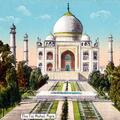
Sheikh Mujibur Rahman, also known as Bangabandhu, the leader of Bangladesh's Independence movement, had this description of visiting the Taj in 1946:
"We left the hotel soon after we had taken our baths since we were all eagerly looking forward to
