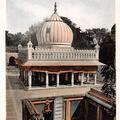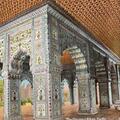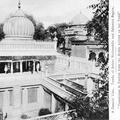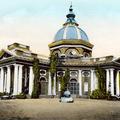
Tombs of Princess Jahanara and Nizamuddin, 4 miles from Delhi
Princess Jahanara's Tomb was built during her lifetime and completed in 1681, the year of her death.
Mr. Hartmann did good publicity in The Picture Postcard, a London-based magazine for early British postcard collectors and enthusiasts. Most likely its editor E. W.
The publisher seems to speak to the Indian customers with this translation perpendicular to the image, and perhaps educate European ones:
[Recto]"Translation in English from the Arabic written on her tomb"
"He is alone everliving and everlasting".
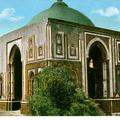
The Alauddin Gate of Delhi is known as Alai Darwaza
[Original caption] Built by Alaudin Khilji in 1310 A.D. [end]
Alai Darwaza is said to be among the first buildings in India to be based on Central Asian and Muslim design principles.
The Cross & Ball Church is known as the St. James Church of Old Delhi inside Kashmir Gate. It was built by James Skinner in 1836. It is said that Skinner was once badly wounded while serving the army. He vowed to build a church in case he survived.
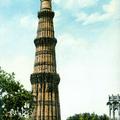
Qutub Minar is among the tallest brick minarets in the world, an important early example of Indo-Islamic architecture built between 1199-1220 ACE. The Mexican writer Octavio Paz described it in his book In Light of India (1995):
"it is difficult to
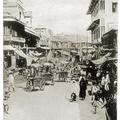
A candid Delhi shot by a little-known photographer.
The Mexican Nobel Prize winner Octavio Paz (1914-1998) served as his country's Ambassador to India in the 1960s, and just before he died left behind a memoir of the country, In Light of India (1995) which has a beautiful description of Humayun's
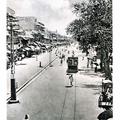
[Original caption on back] This famous street was built by Jahanara Begum daughter of Emperor Shah Jehan. It extends 1520 yards in length from Delhi Fort to Fatehpuri Mosque, and is 40 yards [wide].
[Original caption] Built during the reign of Sultan Rukunuddin and Sultana Razia Begam in 1215 A.D. [end]
Shamsuddin Altamash, wasa 13th century pre-Mughal Muslim ruler of north India, was is better known today as Iltutmish, the third ruler of the