Coronation Darbar 1911 - Delhi
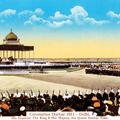
One of an extensive set of series H.A. Mirza & Sons, Delhi's leading photographer and postcard publisher at the time, made of the Darbar.
One of an extensive set of series H.A. Mirza & Sons, Delhi's leading photographer and postcard publisher at the time, made of the Darbar.
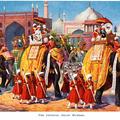
The Delhi Durbar of 1911 was one of the most "postcarded" events of the Raj, and the first time a reigning British monarch, George V and his wife Queen Mary (an avid postcard collector) attended.
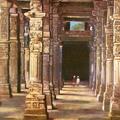
[Original caption] Colonnade, Hindoo Pillars, Kutub Minar. The Pillars, taken by the Mughal conquerors of India from a Hindoo temple, were recut to free them from idols and used to form the colonnade to the mosque.
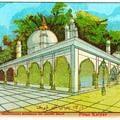
Bhargava’s firm specialised in chromolithographic “god pictures” and other devotional or pious imager of Hindu deities, Sikh gurus, Islamic sites and calligraphic posters.
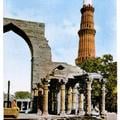
The Quwwat ul Islam Mosque located in the Kutab complex is a magnificent ruin, and a very popular tourist location today. This transformation began much earlier. As Aditi Chandra recounts in her book Unruly Monuments Disrupting the State at Delhi's
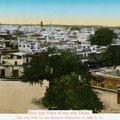
[Original] This city built by the Emperor Shahjahan in 1627 A.D. [end]
![[Connaught Circle, Delhi]](https://www.paperjewels.org/sites/default/files/styles/square_thumbnail/public/slides/connaught-circle_0.jpg?itok=eaSsOHfD "[Connaught Circle, Delhi]")
Connaught Circle was built as part of Lutyen's Delhi between 1929 and 1933 to be the principal commercial plaza of New Delhi. Rangoon Studio was a well-known photographic studio at 58, Janpath and seems to have closed later as rents rose.
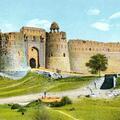
Known as the 'Old Fort' of Delhi, the Purana Qil'a, lies on the eastern edge of Delhi, along the river Jumna.
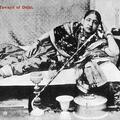
The word "tawaif" comes from the Arabic word "taifa", which means "group" or "troupe." In early India, courtesans were often referred to by the Sanskrit word "ganika". These women were skilled in the arts and entertained wealthy patrons.
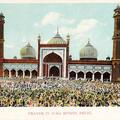
This is a superbly hand-tinted postcard, with both swathes of color (pink and blue) and individual color specs in the crowd mixed with the black ink of the collotype enhancing the effect of a real crowd praying.
