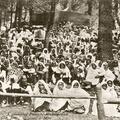
A Group of Punjabi Mohamedan Women & Men
One wonders where this photograph was taken, possibly in the Murree hills but it could have been elsewhere too.
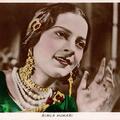
Bimla Kumari was an Indian actress who appeared in films throughout the 1930s, 40s, and 50s and was primarily known as a supporting actress. She may not be as widely remembered as Devika Rani, but she contributed to the early days of Indian cinema.
J.D. Gondhalekar (1909-1981) produced a series of at least ten postcards called "Indian Topics" around 1942, among the few Indian-artist signed postcard series from colonial times.
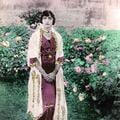
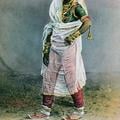
These real photo was both hand-tinted, and, unusually, golden glitter also applied on the woman's wrap.
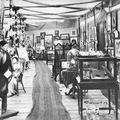
In 1905, a significant exhibition was organized in Bombay (now Mumbai) that marked an important moment in India's colonial and nationalist history. Planned to commemorate the visit of the Prince of Wales (later King George V) to India.
The word "tawaif" comes from the Arabic word "taifa", which means "group" or "troupe." In early India, courtesans were often referred to by the Sanskrit word "ganika". These women were skilled in the arts and entertained wealthy patrons.
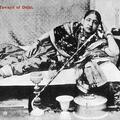
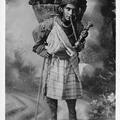
A charcoal seller she may have been, but the nose ring, choker and hookah suggest she had other skills too. This is likely a woman as she seems to be dressed in a typical Pahari style of the era.
While the word "dandy" suggests being fashionable, and may be a secondary meaning, the word is said to actually come from "dandi" or the Hindi/Urdu word for stick, which are used to distribute the woman's weight across them men's shoulders.
Another
King George V (1865-1936) and Queen Mary (1867-1953) visited Peshawar from 2nd to 5th December 1905, as part of the Tour of India, but this real photo postcard was likely printed a decade or two later, so significant was this visit to British
These generic postcards, with a different city slapped on the top signboard and the message, were rare in British India, perhaps because of the most incongruous scene and in this case, forest setting.