6. What is this
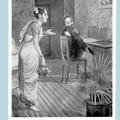
The sixth card in Dhurandhar's series about a new pretty maid who comes into a middle-class household. [Next]
Artist-signed postcards by M.V. Dhurandhar (1867-1944), one of the premiere painters and illustrators around the turn of the century. Dhurandhar became the first Indian head of the J.J. School of Arts and where he was employed throughout his career. Most of these color postcards are from 1903-1904, were halftones and printed in Germany by an unknown publisher. Other cards from later in the decade and thereafter were published by Lakshmi Art Printing Press, and others often for advertising purposes by a variety of publishers in India and as far as Zanzibar.
The sixth card in Dhurandhar's series about a new pretty maid who comes into a middle-class household. [Next]
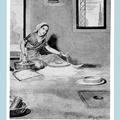
The most interesting of his Dhurandhar's later postcards were printed by The Lakshmi Art Printing Press. The Press belonged to Dadasaheb Phalke (1870–1944), a businessman who once worked at the Ravi Varma Press and had been a student at the J.J.
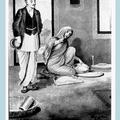
The second card in Dhurandhar's Coquettish Maid Servant Series. [Next]
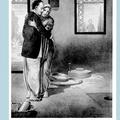
The third card in Dhurandhar's series about a new pretty maid who comes into a middle-class household. Note the chapati flour handprints on the husband's back. [Next]

The fourth card in Dhurandhar's series about a new pretty maid who comes into a middle-class household. [Next]
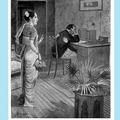
The fifth card in Dhurandhar's series about a new pretty maid who comes into a middle-class household. [Next]
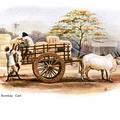
Initialed "MD" in the right corner, Dhurandhar deftly captures early Bombay life. The labourer on the cart nearly falls backwards as he pulls the box up. A pretty tree separates the bullocks from the cart.
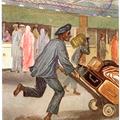
Like the backs of many Dhurandhar cards, this one bears the blind stamp and price ["A.H.W. Rs. 0-1-0," e.g. 1 anna] of A.H. Wheeler & Co., at 47 Hornby Road, the bookstall chain and contractor for advertising on Indian Railways.
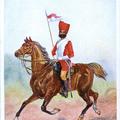
Formed in 1865, the Governor's Bodyguard was a colorful, often-illustrated cavalry in their red and white uniforms and mustachioed Rajput horsemen.
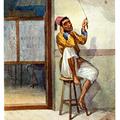
A key figure in the Raj was the punkha boy or man, who pulled the string that moved a fan in a bar or in the sleeping quarters to keep their employers cool.
