Mount Abu. General View.
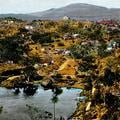
The hill station of Mount Abu, formerly part of the Chauhan Kingdom of Rajasthan, was the summer resort of the Rajput rulers. A green oasis in the barren landscape of Rajasthan.
The hill station of Mount Abu, formerly part of the Chauhan Kingdom of Rajasthan, was the summer resort of the Rajput rulers. A green oasis in the barren landscape of Rajasthan.
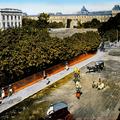
Kolkata is the financial, business and commercial nerve-center of eastern India and capital of West Bengal, and was the first and longest capital of the British Raj in India. On the left is a portion of Government House.
The range of offices in the
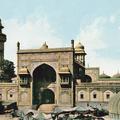
Known for its beautiful "faience" work, a type of fine pottery-tile artwork, the historic Wazir Khan mosque in the walled city of Lahore was built during the reign of the Mughal Emperor Shah Jahan by Shaikh Ilm-ud-din Ansari between 1634 and 1641.
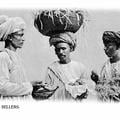
A very popular image, also published in a hand-colored version by D. Macopolo & Co.
Postmarked with no message at the Sea Post Office, likely Bombay May 6, 1905 and sent to Miss Adelaide McConway (sp?), 252 Bishop St., Montreal, Canada.
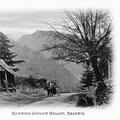
Among the earliest of Fred Bremner's Kashmir postcards, note how carefully the scene has been composed for what would have been a large format albumen shot during a trip he made about 1903: the man seated below the shed, the donkey cart on the road,
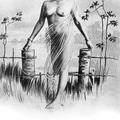
Note the title, which attempts to justify the nude image as some sort of ethnographic study.
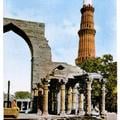
The Quwwat ul Islam Mosque located in the Kutab complex is a magnificent ruin, and a very popular tourist location today. This transformation began much earlier. As Aditi Chandra recounts in her book Unruly Monuments Disrupting the State at Delhi's
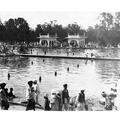
Hector Bolitho, the biographer who spent time in Pakistan in the early 1950s researching his book Jinnah: Creator of Pakistan (1954) wrote this about the Shalimar Gardens:
"While I was in Lahore I made a habit of rising at five o'clock each morning
![Eid Mubarak [Eid Greetings]](https://www.paperjewels.org/sites/default/files/styles/square_thumbnail/public/slides/eid-greetings-4_0.jpg?itok=yxvPcehy "Eid Mubarak [Eid Greetings]")
This lavishly illustrated card, embossed in gold outline, was printed in Germany. It shows how European figures and themes were easily repurposed for local holidays.
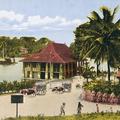
Kandy is still the religious and cultural capital of Sri Lanka, founded in the 14th Century capital of the Sinhalese kingdom from 1592-1815. The name Kandy is derived from the Sinhalese "Kanda uda pas rata", which means "five districts in the
