The Hooseinabad, Lucknow.
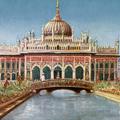
Chota Imambara, a Lucknow landmark, is also called the Husseinabad Imambara, and was built as the mausoleum for Muhammad Ali Shah, the Nawab of Awadh. It was completed in 1838 and is part of the Kaiser Bagh complex.

Chota Imambara, a Lucknow landmark, is also called the Husseinabad Imambara, and was built as the mausoleum for Muhammad Ali Shah, the Nawab of Awadh. It was completed in 1838 and is part of the Kaiser Bagh complex.
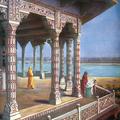
[Original caption] Exterior of Zenana, Agra. Here white marble pavilions look out on delicate inlaid pillars and finely perforated screen's thence across the Jumna.
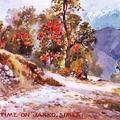
Almost invisible in this painted scene are the two men near the center, half-hidden markers of scale, secret rewards for the perceptive postcard viewer.

The significance of Buddhism in Burma [Myanmar] reflected in a landscape dotted with pagodas. Shwegyin is close to the Indian border on the western side of Myanmar.
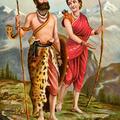
[Original caption] Kirata Bhilli:– God Shankar dressed as a hunter and Goddess Parvati as huntress. [end]
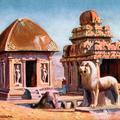
[Original caption] Madras, Seven Pagodas. These extraordinary buildings are to be seen at Mahabilipuram, 35 miles south of the city of Madras.
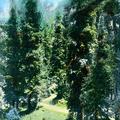
An atmospherically tinted postcard by the Murree-based photographer and publisher D. Baljee.
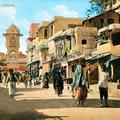
A less common, fairly casual, finely hand-tinted street scene in a then smaller city.
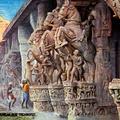
[Original caption] Cavalry of the Gods. Srirangam, near Trichinopoly. The great temple of Sri Rangam is the largest in India. The outer enclosure 2475 feet by 2880 feet contains a bazaar.

[Original caption] A Native Bullock Cart, Northern India. This most popular means of conveyance throughout India is the bullock cart.
