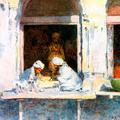
Indian Workers in Silver and Gold
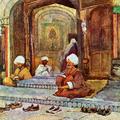
[Original caption] Indian Workers in Silver and Gold. Unaided by mechanical invention, the handwork of these craftsmen is as near perfection as is possible.
[Original caption] Indian Workers in Silver and Gold. Unaided by mechanical invention, the handwork of these craftsmen is as near perfection as is possible.
[Original caption] The Lidder Valley is one of the approaches to the big beautiful State of Kashmere, the favorite holiday resort of the European residents of India.
"Peshawar City was important in Graeco-Buddhist times and its coppersmiths' bazaar must have started then," wrote Randolph Holmes, proprietor of the studio which published this postcard in a later memoir, Between the Indus and Ganges Rivers. "The
[Original caption] Hooseinabad Gateway. Gateway to the tomb of Muhammad Ali Shah, who erected here his own tomb in 1837. The florid excess of stucco ornamentation is but one sign of the decay of Indian architecture in modern days. [end]
One of the
[Original caption] Humayun's Tomb. The first Mogul emperor buried in India, he was contemporary with Henry VIII and died 1565. His widow built the mausoleum and is buried there too.
[Original caption] Dassamedh Ghat. The landing place of the Dassamedh or 10 sacrifices, where the god Brahma is said to have offered horses in sacrifice. [end]
[Original caption] Madras. Chepauk Palace.
[Original caption] Back Bay, from Malabar Hill. A delightful spot where all classes, European and native, congregate to enjoy the fresh and breezy air in the cool of the evening. [end]
[Verso, handwritten] "This is a scene from Malabar Hill on which
[Original caption] Delhi Gate, Agra Fort. The Fort has a circuit of over a mile. Its walls are of red sandstone nearly 70 feet high. There are two entrances, the Delhi Gate being on the West.
An early German missionary postcard showing a view through thick vegetation of the lake at Kodaikanal.
[Original German] Durckblick auf den See in Kodaikanal (Paini-Berge), Ostindien. [end]