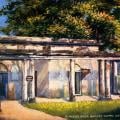
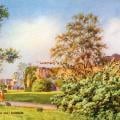
[Original caption] Held by Lieut. Aitkens during the defnense of the Residency. Here fifteen to twenty defenders were killed daily. From Johann's house opposite an African known as "Bob, the Nailer," fired incessantly and never missed a shot. [end]
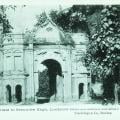
Stormed during the Second Relief of Lucknow, inside the gateway thousands of people were killed in what is sometimes termed a mass killing by British troops, but on this postcard is celebrated as a battle triumph.
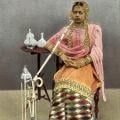
This is the same woman in Dancing Girl, apparently photographed at the same time with Lucknow's Chutter Manzil in the background, but here given a blander description.
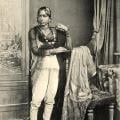
The title comes from a collotype with this title. Here the studio background has been removed, and the hand-coloring is so exquisite, especially the gold, that one could call it "hand-painted," as opposed to the usual stencil hand-tinting found on…
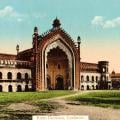
Rumi Darwaza is an iconic gateway located in the heart of Lucknow, India. Built in 1784 by Nawab Asaf-ud-Daula, the fourth Nawab of Awadh, this symbol of the city blends Roman and Awadhi architectural styles, featuring intricate carvings of flowers…
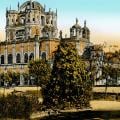
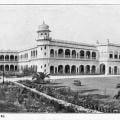
Built in the 1890s by an Englishman, the hotel remains operational under the same name as a venue for marriages and Bollywood films as well a temporary residence for many a politician.
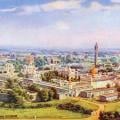
[Original caption] Hooseinabad, (Bird's Eye View) Lucknow. 1,000 yards beyond the Turkish Gate is the Hooseinabad Imambara, and opposite, a beautiful garden, with Clock Tower 220 feet high.
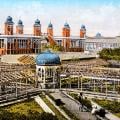
Lucknow was the capital of the Kingdom of Awadh until 1858. Wajid Ali Shah, the king of Awadh, constructed the Kaiser Bagh Palaces of Lucknow in the 1840s and 1850s. Some 8 million rupees were spent on their construction.
[Original caption] The Residency (General View.) Lucknow. The Residency Building is a ruin, though a very beautiful one, but it is possible to ascend the staircase of one of the towers, where throughout the siege (11th June - 17th November 1857) the…