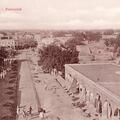
Maharajah's Palace at Jaipur
One of the more richly coloured postcards of the Hawa Mahal, built in 1799. Note the care with which individual blankets have been tinted in the foreground.
Nicknamed the "Eton of the East," renowned for its Indo-Saracenic architecture, blending Mughal, Rajputana, and Gothic styles, it was founded in 1875 to provide modern education to Indian aristocracy, particularly princes and nobles of Rajputana.
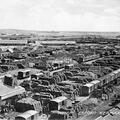
Opened in 1888, the message on this postcard, dated October 12, 1905 (and postmarked in Ambala on Nov. 11) is correct: "Dear Aunt This is about the largest Railway Terminus in the World. with Love from T.H.H."
In one of the earliest series of postcards of India by Tuck, four of the six Kanpur postcards recalled events a half-century earlier; the "Mutiny," as the British called this major uprising against their rule remained very much part of colonial
The Victoria Clock Tower in Jacobabad, Sindh, was built to commemorate Queen Victoria's Golden Jubilee celebrated on February 16, 1887. It was designed by Colonel S. S.
On the occasion of Rabindranath Tagore's birthday on May 7th, a very rare silk postcard of the great writer. The image is printed on silk, which is them stretched over and pasted on cardboard.
Rumi Darwaza is an iconic gateway located in the heart of Lucknow, India.
A poignant hand-painted card by an A. White, likely on this ship as it was leaving India after Independence.
[Original caption] Built during the reign of Akbar the great in 1599 A.D. [end]
An apparently delicately stenciled postcard where the dense but eroded condition of the original panels are veiled by loosely applied tints.
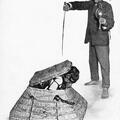
[Original handwriting, verso] "This musical instrument is called Murli. When Krishna brought the snake out of the Jamna river he played on this instrument and on that account he is also known as Murlidhar." [end]