Lala Lajpat Rai
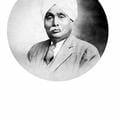
[Original caption on front, shown here] "The blow that was hurled at us this afternoon was a nail in the coffin of the British Empire. Nobody who has seen it is ever likely to forget it. It has sunk deep into our own soul.

[Original caption on front, shown here] "The blow that was hurled at us this afternoon was a nail in the coffin of the British Empire. Nobody who has seen it is ever likely to forget it. It has sunk deep into our own soul.
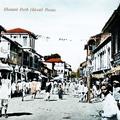
"Bhowani Street" in Pune refers to a street in Bhavani Peth (also spelled "Bhowani Peith" in colonial-era usage), one of the seventeen historic peths (wards/neighborhoods) that constitute old Pune.
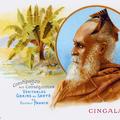
[Original] Cingalais Constipation ses Consequences Veritables Grains de Sante ou Docteur Franck, ([For] Constipation and its
consequences. Spirits beneficial to health from Doctor Franck.) [end]
An early advertising postcard for Doctor Franck's
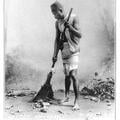
Clifton & Co. published many studio-posed, ethnographic type postcards like this one, made from an albumen print with the firm's title and name inscribed in the negative and visible at the bottom of the frame on this court-sized card.
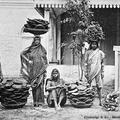
[Verso, in pencil] "You think your job is bad?" [end]
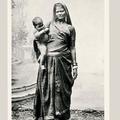
Postmarked Calcutta January 12, 1912 and sent to Ed Froehmer [sp?], Seward, Nebraska, USA.
[Verso] "Calcutta, India January 1012. This is the way that an Indian mother carries her child."
![[Connaught Circle, Delhi]](https://www.paperjewels.org/sites/default/files/styles/square_thumbnail/public/slides/connaught-circle_0.jpg?itok=eaSsOHfD "[Connaught Circle, Delhi]")
Connaught Circle was built as part of Lutyen's Delhi between 1929 and 1933 to be the principal commercial plaza of New Delhi. Rangoon Studio was a well-known photographic studio at 58, Janpath and seems to have closed later as rents rose.
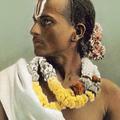
[Original German] Ein Tamulenjungling im Festschmuck, Ostindien. [A Tamil boy in festive adornment]
A memorable portrait by a German missionary organization.
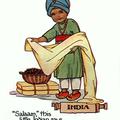
A standard depiction of the colony as a trunk full of raw materials, this series seems to have been started in the 1900-1910 period and persisted into the 1940s.
This postcard is postmarked Anerle, May 5, 1942 and sent to a Miss Pound, Jubilee
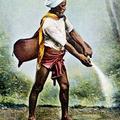
Bhistees supplied water to households and regiments
In the past, water carriers used cured hides of animals to carry water. Today animal hides have been replaced by bottles and jars of plastic.
