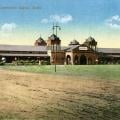
At the 1911 Coronation Durbar in Delhi, “Kingsway” was the imperial processional axis and service corridor tied to the tented Durbar camp, used to move people, troops, and supplies and to stage ceremonial movement in a controlled, spectacular way.
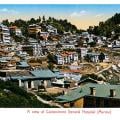
This is probably a view of Murree hillstation from the cantonment hospital. The Mall road runs behind the buildings on the top left, below them is what was known in those days as the "native bazaar."
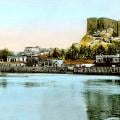
The Nayaks, who founded the city of Tiruchirapalli (Trichy), constructed the Rock Fort Temple. It is as high as 83 meters and is said to be older than even the Himalayas.
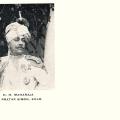
Sir Pratap Singh was particularly close to the British royal family, serving as aide-de-camp to Edward VII from 1887 to 1910 and maintaining ties with Queen Victoria and later George V. He is also credited with popularizing the Jodhpuri suit…
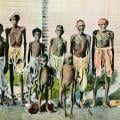
One wonders how long the sitters had to be still in this rigorously posed photograph, where the kid on the far left seems to have moved his right hand, creating a bit of a blur.
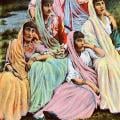
Another version of one of the most popular images of Parsee women in the late 19th, early 20th centuries. Sent to Miss E. Starr, 813 Fulham Road, Fulham, London S.W., England and postmarked Karachi July 29, 1905.
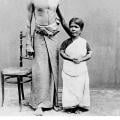
It is unusual for postcards to put two people on an ethnographic postcard, although in this case it was the height contrast that caught the attention of the publisher in this studio shot. Would it have been better had the man not sat down?
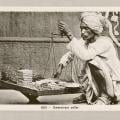
The mithai-wala was a popular postcard subject; in this composition the textile pattern behind the man gives the image energy even as the man stares somewhere far away.