Quetta Fort
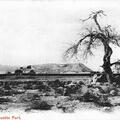
Among the earliest postcards of British Baluchistan, whose capital Quetta was leased from the Khan of Kalat in the 19th century. Bremner was one of the earliest photographers in the cantonment, having come out in the 1890s from Scotland.
Among the earliest postcards of British Baluchistan, whose capital Quetta was leased from the Khan of Kalat in the 19th century. Bremner was one of the earliest photographers in the cantonment, having come out in the 1890s from Scotland.
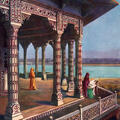
A special embossed Christmas greetings version of this early Tuck's Agra postcard.
[Original caption] Exterior of Zenana, Agra. Here white marble pavilions look out on delicate inlaid pillars and finely perforated screen's thence across the Jumna.
![Greetings from Madras [Message]](https://www.paperjewels.org/sites/default/files/styles/square_thumbnail/public/slides/greetings-from-madras-wiele-klein.jpg?itok=VPBE9a0x "Greetings from Madras [Message]")
This particular card was mailed to France from Chennai on Dec. 25, 1900. Note the entire message is readable, but from what is seems to say:
[Unclear first word] "Happy new year, Mr. Francis. Really it is not cold here. Antoine."
[Original French,
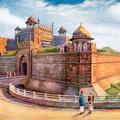
[Original caption] Lahore Gate. To reach the ancient stronghold of the Mughal emperors, you pass under the great Lahore Gate. Its massiveness lightened by domes and arches, gilt and marble on top of it.
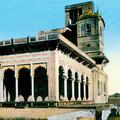
Built in the early 1630s by the Emperor Shah Jehan, the "Palace of Mirrors" or "Crystal Palace" in Lahore Fort is full of glass tiles that reflect light. A UNESCO World Heritage site, the roof was only recently properly restored.
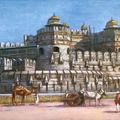
[Original caption] Delhi Gate Fort. The gateway is of red sandstone. The walls are 70 feet high and one mile and a half long. The Europeans and their followers took refuge in the Fort during the Mutiny. [end]
Among the very first Tuck's postcards of
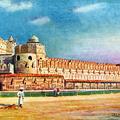
[Original caption] Delhi Gate, Agra Fort. The Fort has a circuit of over a mile. Its walls are of red sandstone nearly 70 feet high. There are two entrances, the Delhi Gate being on the West.
