Juggler with goat and monkey
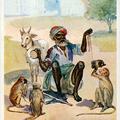
An Dhurandhar portrait of a familiar sight on Bombay streets, the multi-tasking juggler. Note once again the soft city backdrop.
Court card or court sized card was the name given to a size of picture postcard, mainly used in the United Kingdom, which were approximately 4.75 x 3.5 inches and predates the standard size of 5.5 x 3.5 inches (Wikipedia).
An Dhurandhar portrait of a familiar sight on Bombay streets, the multi-tasking juggler. Note once again the soft city backdrop.
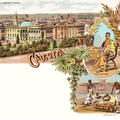
One of the earliest postcards of India, Calcutta, published by W. Rossler, a German or Austrian photographer in the city in 1897. Lithograph, Court sized, Printed in Austria. Undivided back.
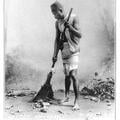
Clifton & Co. published many studio-posed, ethnographic type postcards like this one, made from an albumen print with the firm's title and name inscribed in the negative and visible at the bottom of the frame on this court-sized card.
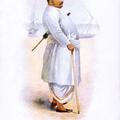
A fine portrait by M.V. Dhurandhar of a Gujarati broker. Gujrati brokers played a pivotal role in Bombay's commercial development during the late 19th and early 20th centuries.

Paul Gerhardt made a number of postcards of the people around the Ravi Varma press in Karli, outside Bombay, including the Katkari in Maharashtra.
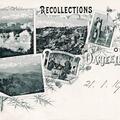
Note how every frame is labelled and the entire ensemble unusually titled "Recollections," which was only occasionally used on multi-view postcards, with "Greetings" the standard term.
Addressed to a Miss H. Scott, c. Dr. J.H.
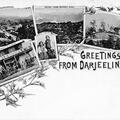
A very early "Greetings from" postcard composed of no less than five different images, including one of the "Divinity Dance by Lamas" in the bottom left panel.
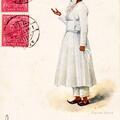
A curious and perhaps not inadvertent confrontation between a Parsi priest and Queen Victoria, he seems to be asking her for something.
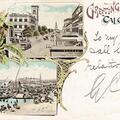
A very early postcard from one of Kolkata's largest retailers. Postmarked Dec. 2, 1898 and addressed to Master Geoffrey Corbett, Whiltey, Yorks., England: "To my godson & all his relations G.C. [sp?]."
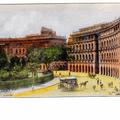
Among the earliest postcards of Bombay from a photograph. One can see the title and photographer inscribed at the bottom of the original glass negative, and the hand-tinting is done in large blocks.
