Bengali Lady
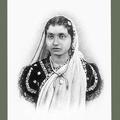
This striking image of a Bengali woman was apparently first published by a Greek tobacconist based in Kolkata, Nestor Gianaclis, and later also published in different variations by D.
This striking image of a Bengali woman was apparently first published by a Greek tobacconist based in Kolkata, Nestor Gianaclis, and later also published in different variations by D.
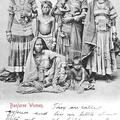
[Recto] "They are called gypsies and live in little straw huts out in the fields. I wrote you once about seeing them. I want to buy a dress to bring home.
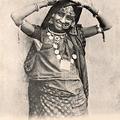
Note how nicely the stamp is positioned in line with the woman's arms; according to the so-called "language of stamps" current at the turn of the century, this stamp position might mean the sender is asking "Do you love me?" or even "Your love
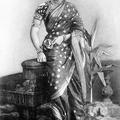
Around the turn of the century, women of Bombay were on the cutting-edge of popular fashion, photographed in studio settings like this one and extensively postcarded.
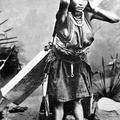
Although taken in the firm's studio, with the woman posing upright, one can from this portrait and the wooden beam infer the literally backbreaking work hillstation workers endured.
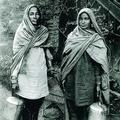
This postcard is likely based on a portrait by Johnston & Hoffmann of 22 Chowringhee [also Chourangi] Road, Kolkata, one of the most storied photographic firms in British India.
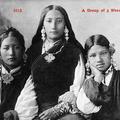
Bhutias are a Sikkimese people of Tibetan ancestry, photographed here most likely in Johnston & Hoffman's Darjeeling studio – compare to A Group of 3 Nepaulese which seems to have the same backdrop.
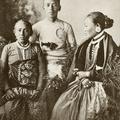
This rare photograph of Nepalis was likely taken in the hillstation of Darjeeling in a studio.
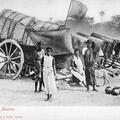
Note the diagonal leading the eye into a rich scene, the figures in the corners of the frame, the tethered cow on the left, the pots in the coals, the vibrancy of this human space under a hoisted banner.
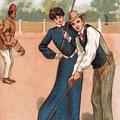
An early view of golf being played in British India, with both a man and woman playing.
