Elphinstone Bombay
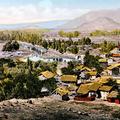
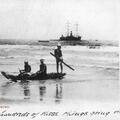
Among the earliest postcards of Bombay from a photograph. One can see the title and photographer inscribed at the bottom of the original glass negative, and the hand-tinting is done in large blocks.
Part of a unique series of court-sized postcards showing the Kolar Gold Fields, India's largest until it was closed in 2001. That series includes Hajee Ismail Saits New Sawmill, Kolar Gold Fields and Extracting Gold, Cyanide Works, Kolar Fields.
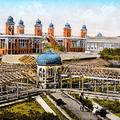
When the Prince of Wales became King George V following his father's death, the Coronation took place at Westminster Abbey in London on June 22, 1911. The event also led to a large gathering of the colonial population on the football field below the
Built during the Akber's Reign in 1599 A.D.
This massive gate was intended to intimidate possible attackers.
Knife grinders are a vanishing craft. Doing this at home before electric knife sharpeners was difficult. Knife grinders would take their sharpening wheels from door to door and take care of the problem.
An earlier postcard view, before divided backs
One can see the rapid transformation of the postcard from a time when messages where only allowed on the front, as in this card.
This postcard was sent from Calcutta in April 1905 to Mr. H.G. Squier, "Actg. [Acting?] P. M. [Postmaster?], Manila, P.I. [Philippine Islands]": "4/28/05 Leave today overland by rail to Bombay. Lytton [sp?]."
This tomb to one of the most revered of Muslim religious teachers in Gujarat was completed in the late 15th century.
Clifton & Co., the first big Bobby-based publisher had numerous versions of this card. This keyhole-style view – a briefly popular postcard type – works well with the curve of what is now Marine Drive opening out towards the waters of Back Bay.
As competition among postcard publishers intensified between 1905 and 1910, each tried to outdo the other with new formats offered by the German printers who served much of the Indian market.