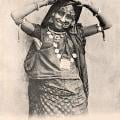
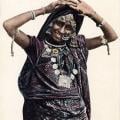
Note how nicely the stamp is positioned in line with the woman's arms; according to the so-called "language of stamps" current at the turn of the century, this stamp position might mean the sender is asking "Do you love me?" or even "Your love…
When this card was first published from London, The Picture Postcard and Collector's Chronicle, a magazine that catered to collectors, businessmen and and aficionados of the new medium, hailed it as a “a fascinating dancing girl from Benares” (Jan.
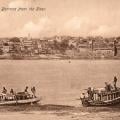
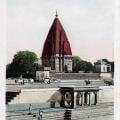
A very nicely hand-tinted postcard, with the red used to seize the eye, setting the temple off against an uneven, unreal application of blue on the terraces below - but who cares?
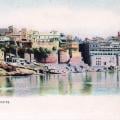
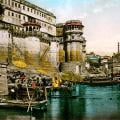
Ganga Mahal Ghat is one of the holiest ghats at Varanasi and was built in the 1830s. Note how the hand-tinting has highlighted, not too carefully, the sun umbrellas in the foreground.
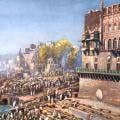
[Original caption] Dassamedh Ghat. The landing place of the Dassamedh or 10 sacrifices, where the god Brahma is said to have offered horses in sacrifice. [end]
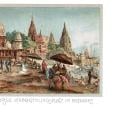
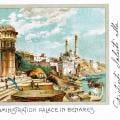
The history of Varanasi, also called Benares, can be traced back to the time of Gautama Buddha 2,500 years ago when it was the capital of Kashi. This is from a series of lithographs by the Austrian painter Josef Hoffmann published in Vienna in 1898.