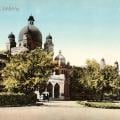
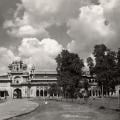
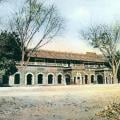
The Lahore Museum was one of the most significant colonial-era museums in British India, established in 1865 and relocated to its current location shown here on Mall Road in 1894.
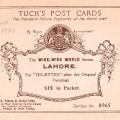
What did a postcard envelope look like? During the early "Golden Age" of postcards, they often came in sets of six, a remnant perhaps of lithographic printing presses where 4 sets of 6 images fit well into the bow that was used to imprint the paper.
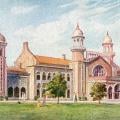
[Original caption] Chief Court, Lahore. This fine building is in the late Pathan style of the 14th century. Between the Court and the Cathedral is a statue of Lord Lawrence who was Chief Commissioner and Lieut. Governor of the Punjab 1853-1859.
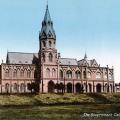
Government College in Lahore opened in 1877 based on a design by the British architect W. Pardon. Adjacent to Anarkali Bazaar and the walled city, it cost over 3 lakh rupees at the time, and the Neo-Gothic clock tower is 176 feet high.
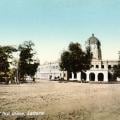
D. C. Mehra's many Lahore postcards are the most extensive color ones of the city, far larger in number than the Tuck's sets which also included one of the Lahore General Post Office.
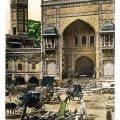
Shaikh Ilm-ud-din Ansari, known as Wazir Khan, built this mosque in the 17th century. Wazir Khan's mosque is in the heart of Lahore's walled inner city, surrounded by narrow lanes and crowded bazaars.
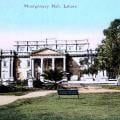
Built in the 1862, and named after one of the first British lieutenant-governors, it "carried European classical architecture into this distant and recently conquered province," according to Thomas R. Metcalf in An Imperial Vision Indian…