Frontier of India
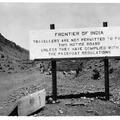
[Original handwriting, Verso] "Oct. 24/[19]29 Visitors to the Khyber [Pass] required to halt 3 mi. from this sign."
[Original handwriting, Verso] "Oct. 24/[19]29 Visitors to the Khyber [Pass] required to halt 3 mi. from this sign."
![Baluchistan Begger [Beggar]](https://www.paperjewels.org/sites/default/files/styles/square_thumbnail/public/slides/baluchistan-beggar.jpg?itok=OPmDWHAl "Baluchistan Begger [Beggar]")
This apparently one-legged man is being used here to represent a type, but what is most eye-catching is the way the veins in his arms seem so like the cracks in the wall.
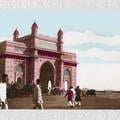
A triumphal arch erected to commemorate the visit of King George V and Queen Mary in 1911, it was completed in its present form in 1924. The Gateway of India was built in the Indo-Saracenic architectural style, combining multiple design elements and
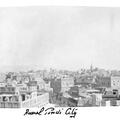
An early real photo postcard of Rawalpindi. These allowed amateurs to directly shoot a postcard in camera, and end up with a photograph which a hundred years later has been faded but can be restored with modern digital tools as this one has been.
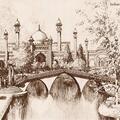
The Indian Pavilion was one of the larger country pavilions at the 1924 British Empire Exhibition held in Wembley, London. Ernest Coffin (1868-1944) was a British artist and illustrator active in the early 20th century.
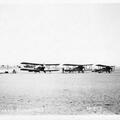
An early British Royal Air Force base in Pishin, Balochistan, near the Afghan border and what was then Northwest Frontier Province where the British were engaged in suppressing tribal resistance throughout the 192s and 1930s.
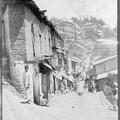
A view from inside the hillstation of Murree's bazaar, usually shown from the top down. The Mall Road is upwards to the left, and was where the European-owned and focussed stores were.
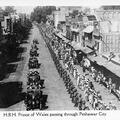
King George V (1865-1936) and Queen Mary (1867-1953) visited Peshawar from 2nd to 5th December 1905, as part of the Tour of India, but this real photo postcard was likely printed a decade or two later, so significant was this visit to British
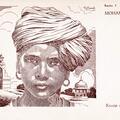
One of the few Dutch postcards of Indians, though these portraits often were striking, like this postcard of a Hindu.
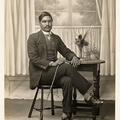
A striking studio portrait – note the painted trees – from the Punjabi garrison town. Only his name is printed on the back.
