[Beegun Songstress of Lucknow]
![[Beegun Songstress of Lucknow]](https://www.paperjewels.org/sites/default/files/styles/square_thumbnail/public/slides/beegun-lucknow-color.jpg?itok=rsZGZMsG "[Beegun Songstress of Lucknow]")
The title comes from a collotype with this title.
The title comes from a collotype with this title.
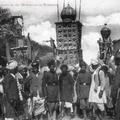
Not too far back, the local Hindu, Sikh and Christian communities would participate in the Shia Taziah processions in Peshawar.
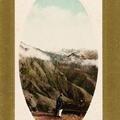
For some unknown reason, Moorli Dhur & Sons most framed, embossed and otherwise uniquely designed postcards are from Chakrata, a cantonment in Dehradun district Chakrata known for its natural beauty, including forests of oak and rhododendron, and
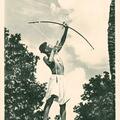
[Original caption, Verso, translated
Santals are an Austroasiatic-speaking Munda ethnic group in Bengal, Bihar and elsewhere.
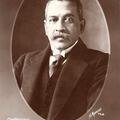
Satyendra Prasanna Sinha, 1st Baron Sinha (24 March 1863 – 4 March 1928), was a prominent British Indian lawyer and statesman who achieved several notable firsts, including being the first Indian to become Advocate-General of Bengal (1905), first
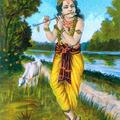
[Original handwriting, verso] "This musical instrument is called Murli. When Krishna brought the snake out of the Jamna river he played on this instrument and on that account he is also known as Murlidhar." [end]
![Guerre 1914 - Hindu Fumant La Pipe [Indian Smoking a Hookah]](https://www.paperjewels.org/sites/default/files/styles/square_thumbnail/public/slides/guerre-1914-hindu-fumant-la-pipe.jpg?itok=kwDQFF8z "Guerre 1914 - Hindu Fumant La Pipe [Indian Smoking a Hookah]")
Postmarked May 24, 1919, some six months after World War I was over, though the card itself is probably dated earlier. Note the European man apparently smoking a pipe in the background.
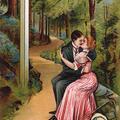
These generic postcards, with a different city slapped on the top signboard and the message, were rare in British India, perhaps because of the most incongruous scene and in this case, forest setting.
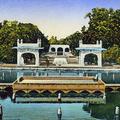
The beautiful gardens adjacent to the present-day Pakistan-Indian border were build during the reign of the Mughal Emperor Shah Jahan.
Built in the year 1641 A.D, the Shalimar Gardens in Lahore are a UNESCO World Heritage Site.

Government House in Peshawar was completed in 1903, and has been expanded while keeping the same design since. The angle and style of photographs of Government Houses throughout the Raj were meant to assert the authority of the colonial regime.
