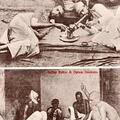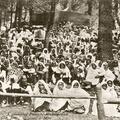
A Group of Punjabi Mohamedan Women & Men
One wonders where this photograph was taken, possibly in the Murree hills but it could have been elsewhere too.
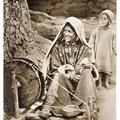
Kashmiri women are often shown spinning on postcards because this was an important economic activity in the region.
This apparently one-legged man is being used here to represent a type, but what is most eye-catching is the way the veins in his arms seem so like the cracks in the wall.
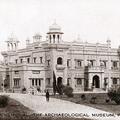
The Victoria Memorial Hall in Peshawar, established in 1907, evolved from a British colonial ballroom into a significant archaeological museum.
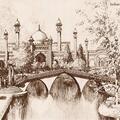
The Indian Pavilion was one of the larger country pavilions at the 1924 British Empire Exhibition held in Wembley, London. Ernest Coffin (1868-1944) was a British artist and illustrator active in the early 20th century.
What did a postcard envelope look like? During the early "Golden Age" of postcards, they often came in sets of six, a remnant perhaps of lithographic printing presses where 4 sets of 6 images fit well into the bow that was used to imprint the paper.
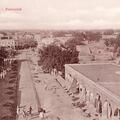
Postmarked [illegible date] Rawalpindi, addressed to Miss. L. Ballinger, Montrose House, 155 Uxbridge Road, Shepherd's Bush, London, England, with this message on the back:
"This place is the same as a Town in England I Remain Your Old Dear Best."
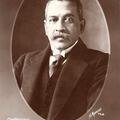
Satyendra Prasanna Sinha, 1st Baron Sinha (24 March 1863 – 4 March 1928), was a prominent British Indian lawyer and statesman who achieved several notable firsts, including being the first Indian to become Advocate-General of Bengal (1905), first
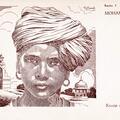
One of the few Dutch postcards of Indians, though these portraits often were striking, like this postcard of a Hindu.
Many of the very few postcards of Bangladesh from pre-Partition times are by Catholic missionaries in Mymensingh in particular, here shown incongruously on a bullock cart.
[Original French title] Catechistes Missionnaires de Marie Immaculee -