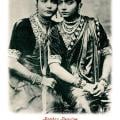
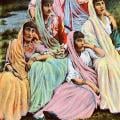
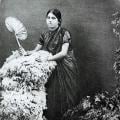
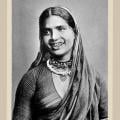
This postcard actually shows a young Gohar Jan (right) and her mother Malka Jan, both famous dancers and singers. Gohar Jan was the first recorded Indian artist, by the Gramophone company in 1904. She can be heard on YouTube.
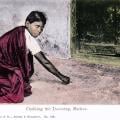
The Kolam tradition of creating complex geometric patterns, often passed down from mother to daughter, out of rice flour or chalk in front of the home is an ancient tradition in South India and elsewhere.
This so-called "chromo-collotype" card was created by running an image derived from a black and white photograph through multiple color runs, after each color had dried, creating rich and translucent images.
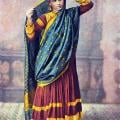
Another version of one of the most popular images of Parsee women in the late 19th, early 20th centuries. Sent to Miss E. Starr, 813 Fulham Road, Fulham, London S.W., England and postmarked Karachi July 29, 1905.
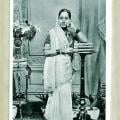
Nicolas Brothers opened a studio in Calicut [Kozhikode], a coastal city in Kerala State as early as the 1860s. The rounded top of this image suggests that it was originally an albumen photograph.
Smiles on postcards from the early 1900s are rather rare, possibly because most portraits required the sitter to stay still for many seconds while the exposure was made, especially in the 19th century when most portraits were struck and re-purposed…