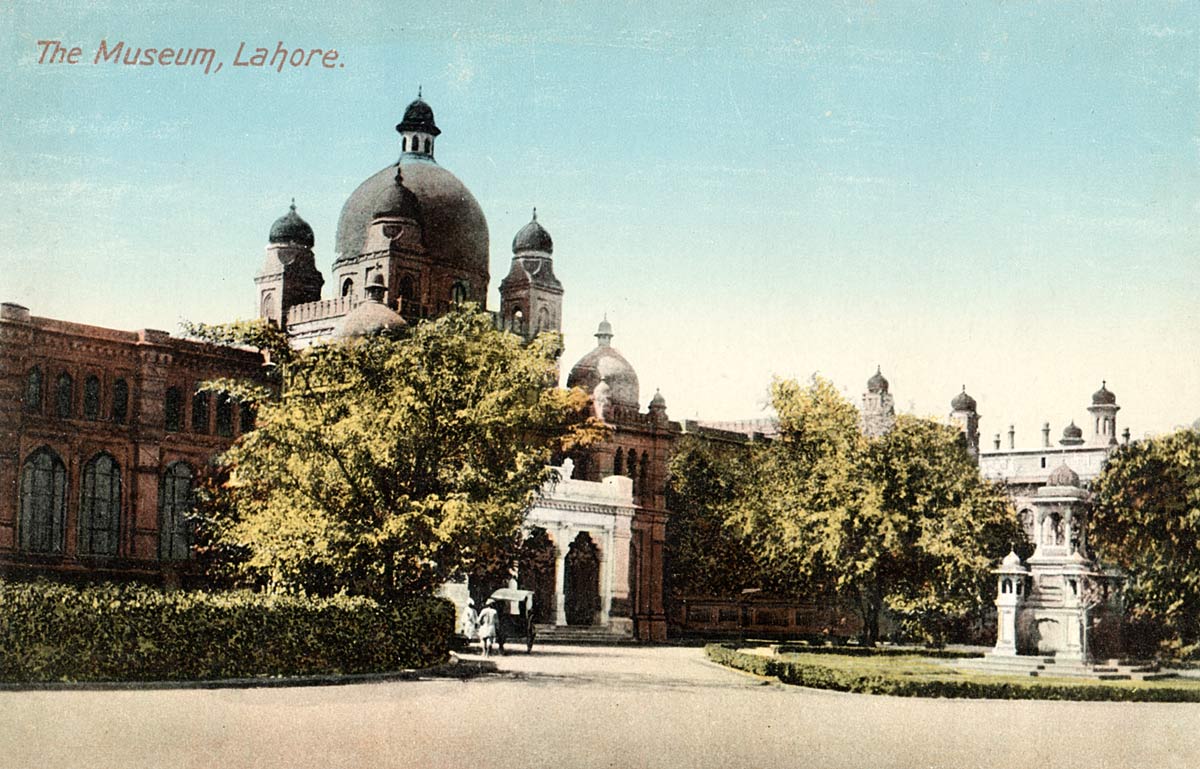
The Lahore Museum was one of the most significant colonial-era museums in British India, established in 1865 and relocated to its current location shown here on Mall Road in 1894. A few years later it became world famous when Rudyard Kipling began his novel Kim (1901) outside the museum his father had helped set-up. The museum building exemplifies Indo-Saracenic architecture, blending Victorian Gothic Revival elements with traditional Indian architectural features. This architectural style was designed by Bhai Ram Singh with Kipling's father, and built by Sir Ganga Ram, another famous Lahore figure and philanthropist. The museum houses approximately 60,000 artifacts spanning multiple civilizations and religions including Gandharan sculptures, Islamic decorative arts, Rare manuscripts and paintings, Ancient coins (40,000 specimens dating back to the 6th century), Indus Valley artifacts and more. Despite some collections being removed to India after Partition, it remains Pakistan's largest museum and one of its most visited cultural institutions.
The Museum, Lahore
c. 1910
13.85x
8.95cm